
In the rapidly evolving field of artificial intelligence (AI), the development of reasoning models has become a focal point for both research institutions and industry leaders. OpenAI’s o1 model, introduced in September 2024, marked a significant advancement in AI’s reasoning capabilities. Notably, Chinese AI lab DeepSeek has recently released its R1 model, claiming performance on par with, or even surpassing, OpenAI’s o1 on specific benchmarks. This blog post delves into the features, performance metrics, and implications of DeepSeek’s R1 in comparison to OpenAI’s o1.
Overview of OpenAI’s o1 Model
OpenAI’s o1 model represents a shift from traditional large language models (LLMs) towards what the company describes as “reasoning” models. Unlike earlier models that primarily relied on predictive text generation, o1 incorporates a “chain of thought” reasoning technique, enabling it to evaluate and revise its output iteratively. This approach enhances its proficiency in tasks requiring logical deduction, such as mathematical problem-solving and code generation. However, despite these advancements, demonstrations have revealed instances where o1 made fundamental errors, highlighting the challenges inherent in developing robust reasoning AI.
Introduction to DeepSeek’s R1 Model
On January 20, 2025, DeepSeek unveiled its R1 model family, releasing it under an open MIT license. The flagship model boasts 671 billion parameters, positioning it among the most extensive AI models available. In addition to the primary model, DeepSeek introduced six distilled versions, ranging from 1.5 billion to 70 billion parameters, catering to a variety of hardware capabilities. Notably, the smallest models are optimized for laptop use, while the largest require substantial computational resources.
Performance Benchmarks
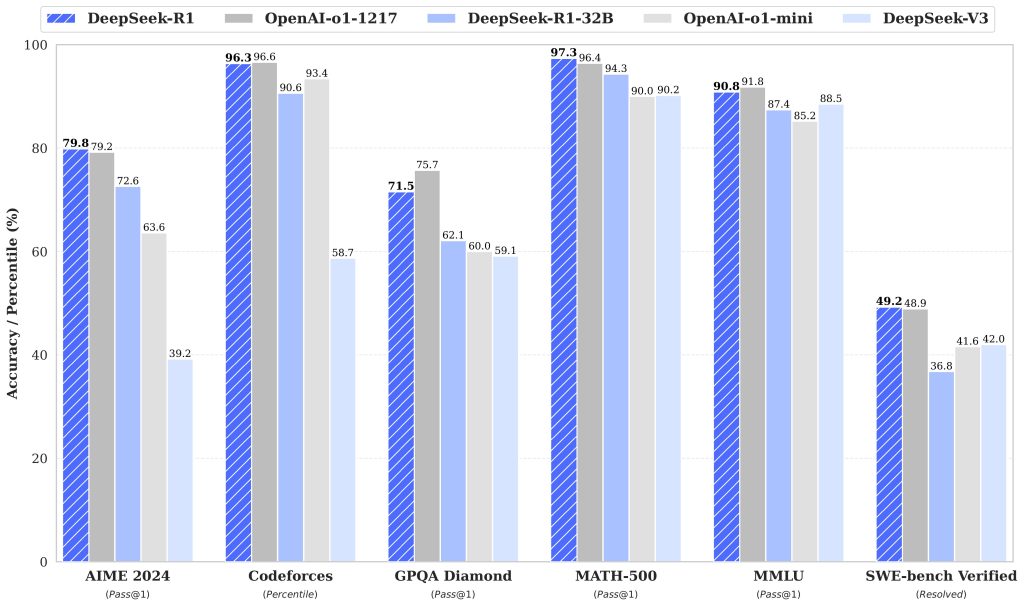
DeepSeek asserts that R1 outperforms OpenAI’s o1 on several key benchmarks:
- AIME (American Invitational Mathematics Examination): A prestigious mathematics competition assessing high-level problem-solving skills.
- MATH-500: A collection of complex mathematical word problems designed to evaluate an AI model’s reasoning capabilities.
- SWE-bench Verified: A programming assessment tool measuring proficiency in software engineering tasks.
While these claims are promising, it is essential to approach them with caution until independent evaluations confirm the results. Benchmark performance can vary based on numerous factors, including dataset selection and evaluation criteria.
Open-Source Accessibility
A distinguishing feature of DeepSeek’s R1 is its open-source nature. By releasing the model under the MIT license, DeepSeek enables researchers and developers worldwide to access, modify, and deploy the model without restrictive licensing constraints. This openness fosters collaboration and accelerates innovation within the AI community. In contrast, OpenAI’s o1 remains proprietary, limiting external contributions and adaptations.
Implications for the AI Landscape
The introduction of DeepSeek’s R1 signifies a notable advancement in China’s AI capabilities, challenging the dominance of Western organizations like OpenAI. The availability of a high-performing, open-source reasoning model democratizes access to advanced AI technologies, potentially leveling the playing field for smaller entities and researchers with limited resources. Moreover, the open-source release may prompt proprietary model developers to reconsider their strategies, balancing commercial interests with the broader benefits of open collaboration.
Challenges and Considerations
Despite the promising developments, several challenges persist:
- Verification of Claims: Independent assessments are necessary to validate DeepSeek’s performance claims, ensuring the model’s reliability across diverse applications.
- Resource Requirements: Running large models like R1 necessitates significant computational resources, potentially limiting accessibility for individuals or organizations without high-performance hardware.
- Ethical and Security Concerns: The proliferation of advanced AI models raises ethical questions and security risks, including the potential misuse of technology for malicious purposes. Ensuring responsible development and deployment is imperative.
Conclusion
The emergence of DeepSeek’s R1 model represents a significant milestone in the AI field, showcasing the rapid progress of Chinese research institutions in developing advanced reasoning models. While OpenAI’s o1 has set a high standard, DeepSeek’s open-source approach with R1 introduces a competitive dynamic that could drive further innovation and accessibility in AI technologies. As the landscape evolves, ongoing evaluation, collaboration, and ethical considerations will be crucial in harnessing the full potential of these advancements for the benefit of society.
Sources: